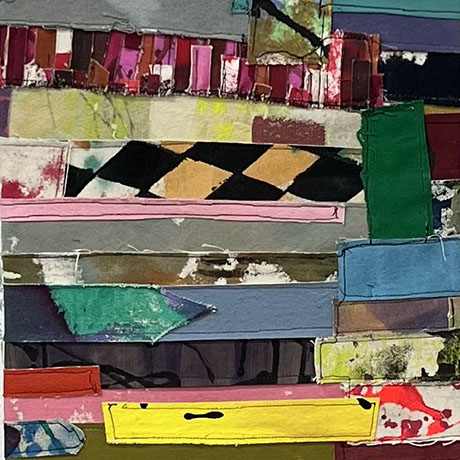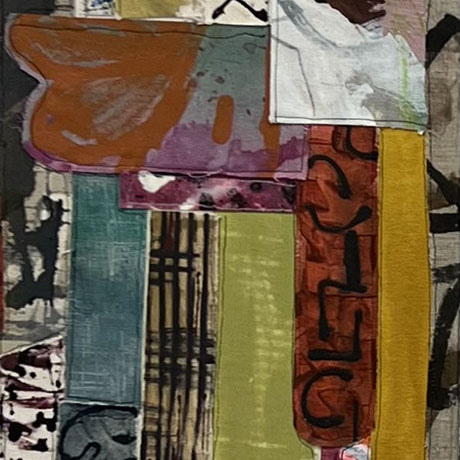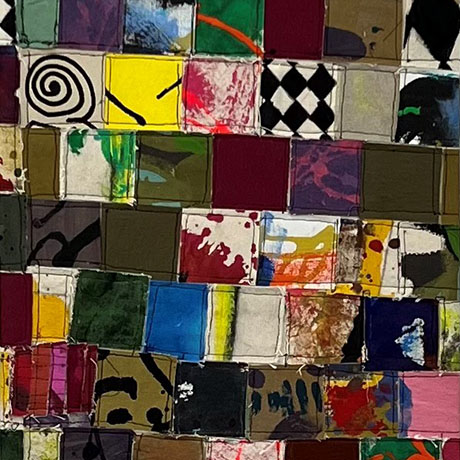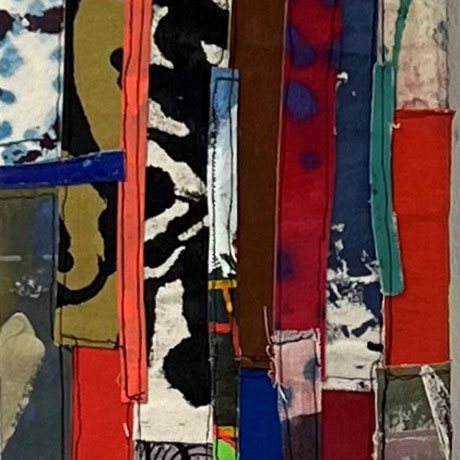
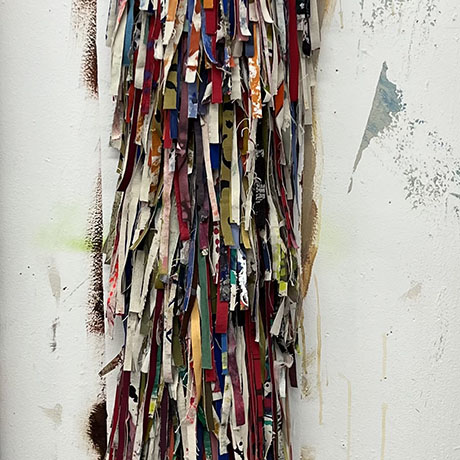
Totem (Threads) by Denise Lacarra
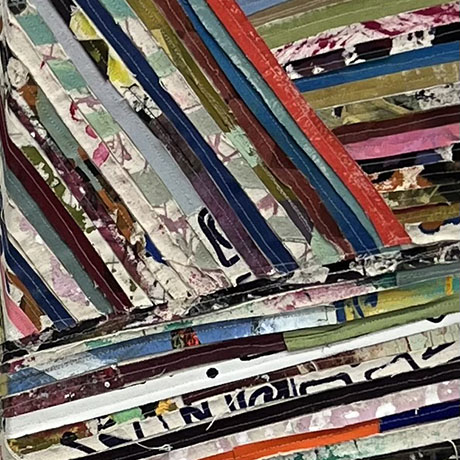
Totem (Woven) by Denise Lacarra
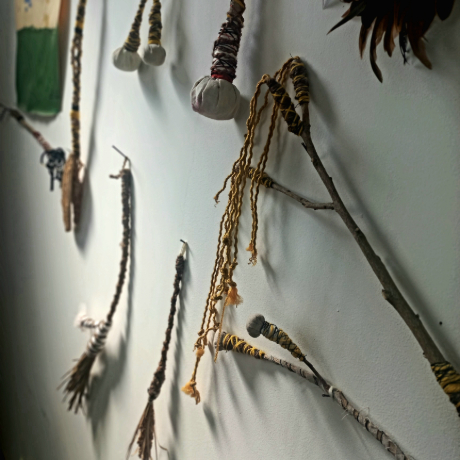
Wildcrafted Tools by Denise Lacarra
Weft and Memory
Denise Lacarra
June 4 – July 19, 2025
ABOUT THE EXHIBITION
In the work of Denise Lacarra, painting decomposes and recomposes in a process that challenges its own material limits. Fragments of previously painted canvases are cut, recombined, and sewn together, generating compositions where the visual memory of each stroke overlaps with new configurations. Thus, her practice operates like a palimpsest, in which time and the pictorial gesture are inscribed in each layer of the work.
Lacarra is situated in a hybrid territory between expanded painting and textile practice, establishing connections with artists such as Jacques Villeglé, whose fragmentation of urban visual language reveals hidden narratives, and Anni Albers, whose exploration of fabric as a compositional structure resonates in the way the artist intertwines and embroiders her materials. However, far from a mere reference, her work offers its own dialogue with painting as a flexible, mutable, and constantly transforming object.
The artist uses tools made from natural elements—branches, threads, yarn, and fabrics—to paint, which become extensions of the body and the landscape. Each stroke reflects the intimate connection between human gesture and living matter. This technique invites a reconsideration of the relationship between art and nature, erasing the boundaries between creation and environment.
The resulting pieces evoke rhythms and tensions between the spontaneous and the structured, where the randomness of the fragment finds balance in the rigor of the assembly. In this process, Lacarra not only questions the traditional boundaries of the pictorial medium but also expands its narrative potential, establishing new readings based on what has been rescued, decomposed, and rearticulated.
ARTIST STATEMENT
Denise Lacarra is a visual artist based in Tijuana, Mexico. Her practice develops in the binational context of the border between Mexico and the United States, which subtly influences her relationship with gesture, materials, and processes. Her work investigates painting as a field of formal exploration, where spontaneity and control coexist. Through free strokes and deliberate use of color, the pictorial surface becomes a space of direct communication. Over time, Lacarra has integrated textile techniques such as sewing and assembly, expanding her visual language into compositions that oscillate between painting and object.
These approaches bring a material dimension that emphasizes the relationship between texture, structure, and time. Their creative process is primarily intuitive, with an emphasis on the recording of gestures and openness to change. Each piece reflects an active relationship between the body and matter, exploring transformation as an essential part of artistic work. Over more than two decades, they have developed a sustained practice that combines craftsmanship, experimentation, and cross-border continuity. They have participated in artist residencies in France and Italy and have received training in various independent art programs in Southern California and Tijuana.
ABOUT THE ARTIST
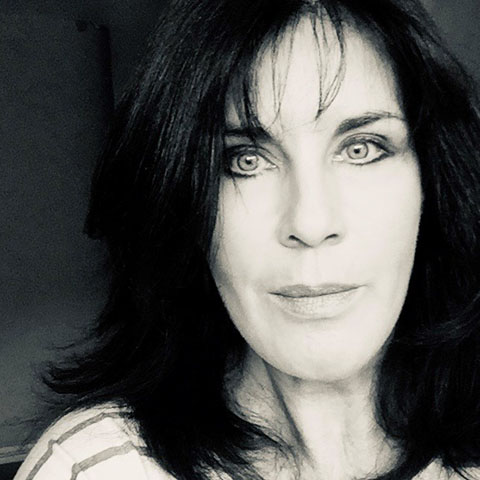
Denise Lacarra
Denise Lacarra is a visual artist based in Tijuana, whose practice focuses on expanded painting and experimentation with textile techniques such as sewing and assembly. She trained in independent programs and workshops in Southern California and Baja California, including Athenaeum School of the Arts (La Jolla), Losina Art Center (San Diego), Watts Atelier of the Arts (Encinitas), and studios with E. Ciapara in Tijuana. She has participated in group exhibitions in Mexico, the United States, Italy, and France, and has presented three solo exhibitions: Conatus (Galería Benjamín Serrano, Tijuana, 2014), Devenir (Galería Casa Valencia, San Diego, 2016), and Parajes Perdidos (Museo de la Vid y el Vino, Valle de Guadalupe, 2019). Since 2001, Denise has annually conducted stays in Italy dedicated exclusively to painting, which are a fundamental part of her creative process and constant artistic exploration. Her work addresses the intersection of body, matter, and territory from a cross-border perspective.
EXHIBITION GALLERY