About the Exhibition
The works in Unsettled Artifacts record my process of unpacking and coming to terms with the potent personal memories and collective histories embedded in my family archives from rural Minnesota. My practice brings family archival documents into conversation with my photographs from Dakota and Ojibwe lands in Minnesota to unsettle the certainties of archives and open up new ways to imagine relational histories of land and people.
My family no longer owns the land of my grandparents in Minnesota. But I am the custodian of my grandfather’s family photographs, farmland deeds, plat maps, and documents that speak to a history that made that land legible as property, inheritance, and individual belonging and that eliminated our understanding of Indigenous collective relation to that land. That’s why these documents can exert such a pull on us. They don’t just say who owned land—they say who was authorized to belong, and under what conditions. By placing my family archive within a wider Indigenous geography and history that exceeds it, my work explores the ways settler memory is always situated within Indigenous land, even when it refuses to recognize that fact.
I use the techniques of weaving–of photos and documents—to unsettle the certainties that legal documents and photographs present. I work with fine art photo paper, transparent film, and milky, partially opaque mylar to create conflicting layers. I think of these pieces as a kind of counter-document, where I enact an interruption within a document itself that allows a sense of the organic, of embodied land use, to disrupt the rational map grid.
This moment of deep conflict in the US inspires me to return to the archive, to use the past to produce a more nuanced history of the present. I invite my audience to think about how land and belonging are subject to those who make meaning, and with what materials and ruptures new stories can be told.
See our YouTube channel for more content about our exhibitions.
Learn more about the lecture Jill Marie Holslin is giving on May 23: “Unsettling the Archive: Reweaving the Stories We Inherit.”
Exhibition Gallery
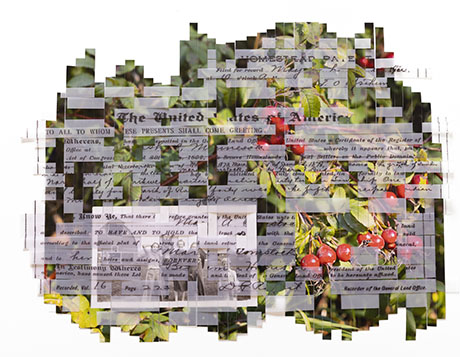
Canpa / Chokecherry 2025
Fine art photographic print and mylar. Photo weaving.
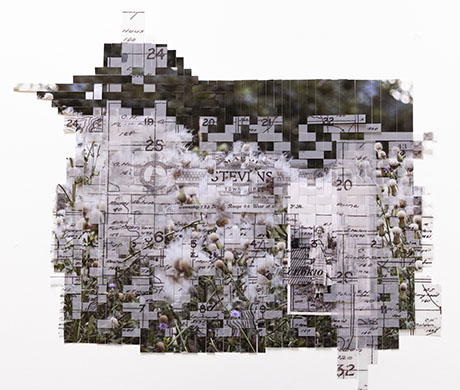
Cokaya / Chokio 2025
Fine art photographic print and mylar. Photo weaving.
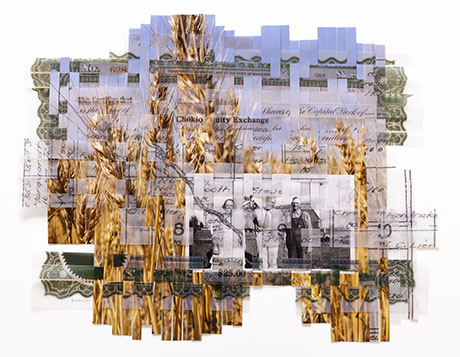
Esa Tonka / Wheatfield at Fort Ridgely 2025
Fine art photographic print and OHP transparent film. Photo weaving.
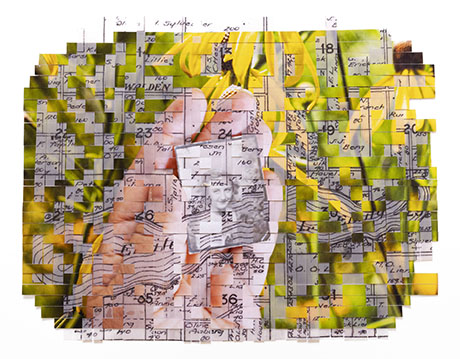
Hanske / Walden 2025
Fine art photographic print and mylar. Photo weaving.
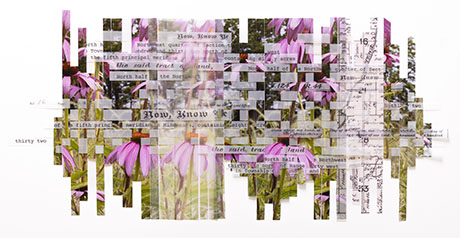
Ichahpe-Hu / Now Know Ye 2026
Fine art photographic print and mylar. Photo weaving.
Artist’s Statement
As a transborder artist, I gather together fragments from my everyday life, from archives and photographs, trying to give shape to an existence of constant movement. My life on the international border between Mexico and the United States creates constant ruptures in my everyday normality. Always crossing between a “here” and a “there.” Aquí se habla español then to English, and then back to Spanish again. These kinds of misalignments shake us, and our perception begins to change.
In my practice, I cross back and forth between digital and analog, using the digital — camera, scanner, and printer — along with the analog — fine art papers, X-Acto knife, and cutting mat — as my creative tools. I seek out friction and disjunction to challenge our conventional ways of thinking about place, belonging, and memory. I make photographs outdoors in the landscape and bring them together with print artifacts and archival photos. In my studio I print, cut, and restage my materials to create constructed photographs, artist books, and video works in which I make my hand and body visible, active agents in my compositions, holding and arranging archival materials, documents, and maps. My gestures remind me that the archive is not simply a record of the past, but a site to imagine new futures.
By layering materials, my pieces index multiple temporalities and places, destabilizing the perception of a fixed, stable reality in the photograph or the archive. I invite my audience to experience a little bit of friction, a misalignment between what they expect and what they see. To experience the recoding of meaning. To think about how land and belonging are subject to those who make meaning, and with what materials and ruptures new stories can be told.
About the Artist
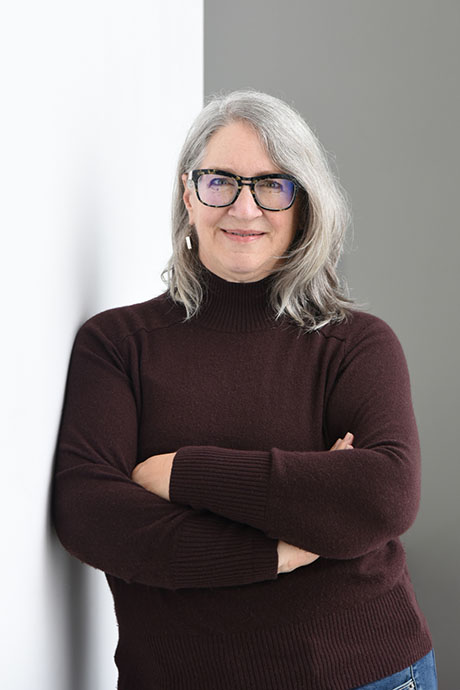
Jill Marie Holslin
Jill Marie Holslin (b. 1960) is a visual artist working between digital and analog methods to explore themes of place, memory, and belonging. Rooted in her experiences of over 35 years living in Mexico and Southern California, after a childhood in rural Minnesota, her art reimagines the archive as a dynamic space where personal and collective histories intersect, challenging fixed narratives of land and identity. Holslin holds an MFA from the School of Art and Design at San Diego State University and studied contemporary art and photography in several independent programs including the Contemporary Photography Program (PFC) in Mexico.
In 2023 and 2024, she was awarded research grants by San Diego State University to work in the archives of the Library of Congress in Washington D.C. and the Minnesota History Center in St. Paul. Her photographic and audiovisual work has been exhibited in Mexico and Latin America, the United States, and Europe, and she has been recognized as a selected artist in photography awards in Baja California, Nuevo Leon, and Sonora, Mexico. In 2025, her video-essay was selected in the Concurso of Experimental Video of Baja California. As an arts writer, her essays have been published in exhibition catalogs and academic and arts publications. She has lived in Tijuana, Baja California, Mexico, since 2011.
Financial support is provided by the City of San Diego.

This activity is supported in part by the California Arts Council, a state agency.
This exhibition is generously supported by Handwork 2026.