
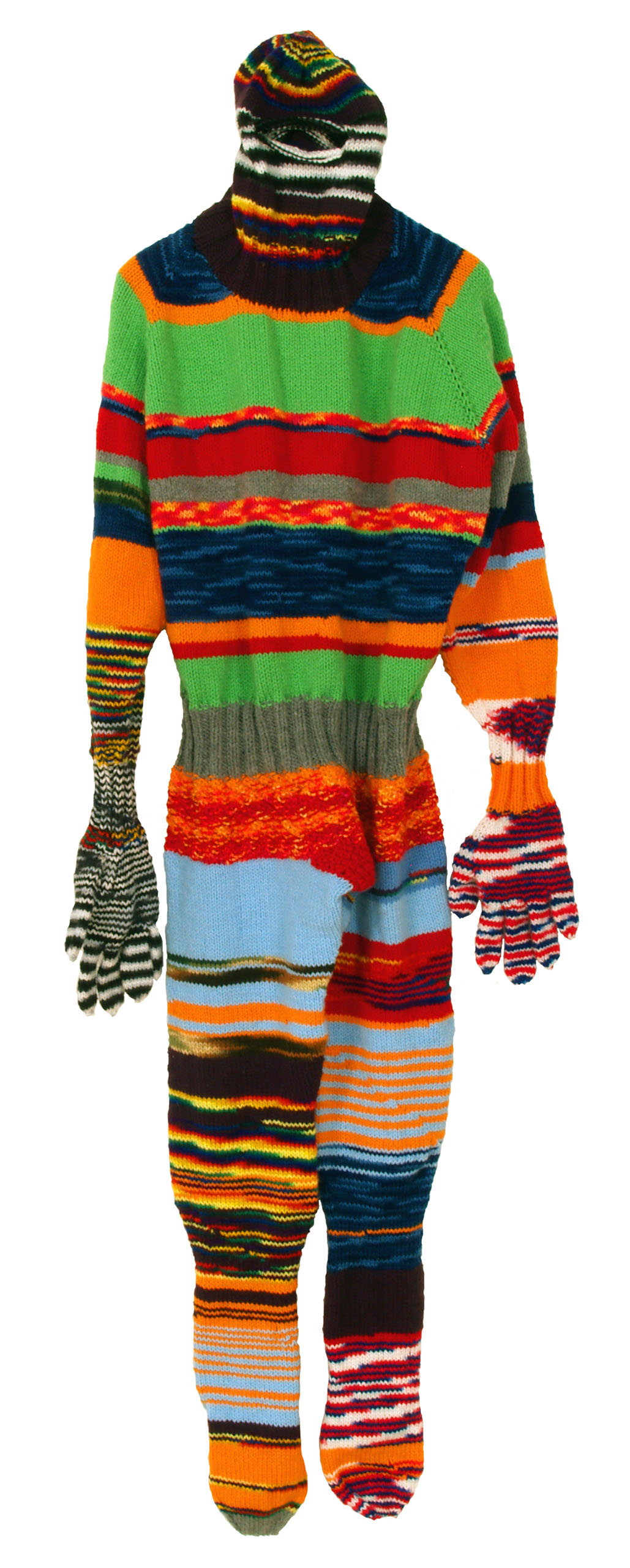
Endsman
Mark Newport
80 x 23 x 6 inches
2010
ABOUT THE ARTIST
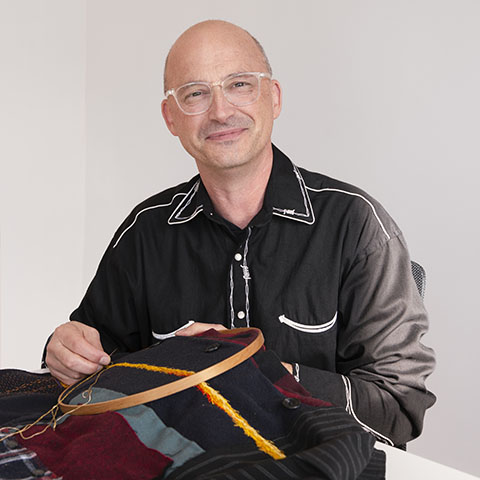
Mark Newport's work uses textiles, performance, print, and photography to reveal the vulnerability inherent in traditional western ideals of masculinity.
His work was included in the prestigious Hangzhou Triennial of Fiber Art 2019, China; the 2019 Rijswijk Textile Biennial, The Netherlands, as well as in group exhibitions at the Textile Museum of Canada, The Mint Museum, and The Museum of Arts and Design. He has had solo exhibitions at The Arizona State University Art Museum; The Cranbrook Art Museum; and The Chicago Cultural Center.
Newport's work has been recognized with a Louis Comfort Tiffany Foundation fellowship, a 2011 Artist Fellowship from the Kresge Foundation, and a Creative Capital Foundation grant. His work is in the collections of The Whitney Museum of American Art; The Renwick Gallery; The St. Louis Art Museum, The Racine Art Museum; and private collections.
Matéria Contemporary Art Gallery in Detroit and Greg Kucera Gallery in Seattle represent his work.
ARTIST STATEMENT
Endsman is from a series of heroes of my own invention. This series pushes the image of the hero by highlighting the process and materials of knitting in the form of the costume. Endsman is from a tradition of sweaters that were made with yarn leftover from other projects, which result in unpredictably striped garments.
Mending work:
We hurt each other. Small transgressions, thoughtless acts, and inattentiveness wound as surely as intentional actions. Intentional or not, mindless or targeted, repeated actions can fray personal relationships and tear at social structure, society, and community.
Garments are intimately connected to us, a second skin. Clothing mediates our physical and emotional experiences, while absorbing our internal reactions and the influences of the world around us. The cloth in my work comes from thrift stores. The suits, pants, and shirts evoke their prior owners and the community they lived in.
In textile, like the body, we stitch to reconnect what has come apart. Repeated acts of stitching tend body and garment. I dissect garments, usually along the seams, and collage the parts together into a new whole. Then I cut into these collages, making holes. Using historic mending techniques, I weave new cloth into the hole and suture cuts. These interventions leave scars.
Scars are new skin (or cloth), evidence of pain and growth. They look and feel different than the skin (or cloth) around them acknowledging the damage caused, the wound healed, and the hope inherent in growth.
Costumes: Batman, Iron Man, Spiderman and the Rawhide Kid
These characters are childhood memories of the ultimate man – the dad every boy wants, the man every boy wants to grow up to be. My hand knit acrylic re-creations of these heroes' costumes combine their heroic, protective, ultra masculine, yet vulnerable personas with the protective gestures of my mother – hand knit acrylic sweaters meant to keep me safe from New England winters. The costumes are life-size, my size, wearable objects that hang limply on hangers challenging the standard muscular form of the hero and offering the space for someone to imagine themselves wearing the costume, becoming the hero. They become the uniforms I can wear to protect my family from the threats (bullies, murderers, terrorists, pedophiles, and fanatical messianic characters) we are told surround us.
The Sweatermen, Valuesman, Spiritmen, and Ribbed are heroes of my own invention. They push the image of the hero by highlighting knitting materials, textures, and traditions (cables and the use of "ends" to make a sweater) in the form of the costume. Some of the color and texture choices are based on the sweaters my mother made, her love of cables and her color choices. In these I work to forge the link between childhood experience and an adult understanding of protection, masculinity, and heroism.
MATERIALS AND TECHNIQUES
Acrylic yarn and buttons.
Hand knitting.